What to Look for in a RAG Development Company: Hybrid Search, Vector Vaults & Zero-Hallucination Guarantees
An enterprise RAG development company engineers high-accuracy document intelligence pipelines that connect foundation language models to private enterprise knowledge repositories. Production RAG requires layout-aware parsing, hybrid search synthesis (dense embeddings + BM25 keyword matching), neural reranking, and page-level source citations.
Direct Answer: What Is an Enterprise RAG Development Company?#
An enterprise RAG (Retrieval-Augmented Generation) development company specializes in engineering intelligent search and answer systems that ground foundation language models in verified, private organizational documentation. By pairing dense vector databases with sparse lexical search engines, advanced document parsers, and neural rerankers, a specialized RAG engineering firm eliminates generative hallucinations and provides employees or customers with instant, page-level verified citations across thousands of complex PDFs, contracts, database tables, and standard operating procedures.
When hiring a RAG development company, enterprise technical buyers should verify three non-negotiable capabilities: the implementation of hybrid search combining dense semantic embeddings with sparse keyword search (BM25), document chunking strategies that respect semantic hierarchies rather than arbitrary token boundaries, and strict confidence scoring thresholds that escalate queries to human operators whenever context similarity falls below predetermined benchmarks.
+--------------------------------------------------------------------------+
|              PRODUCTION HYBRID RAG SYSTEM PIPELINE                       |
+--------------------------------------------------------------------------+
| 1. INGESTION  : Layout-Aware PDF/Doc Parsing | Semantic Hierarchical Chunk|
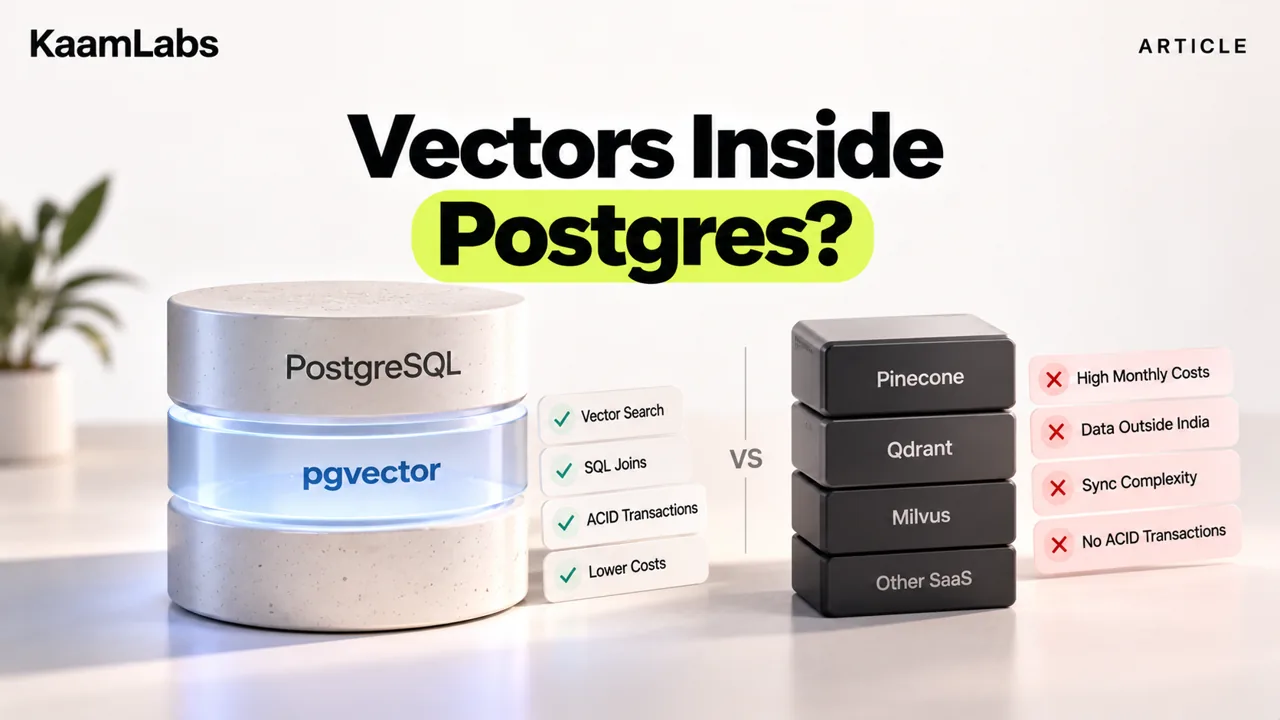
| 2. EMBEDDINGS : High-Dimensional Domain Vectors | Stored in pgvector      |
| 3. RETRIEVAL  : Hybrid Query Bus (Dense Vector + BM25 Full-Text Keyword)  |
| 4. RERANKING  : Neural Context Reranker | Top-K Scored Context Selection  |
| 5. GENERATION : Prompt Synthesis with Grounded Page Citations             |
+--------------------------------------------------------------------------+
1. Why Naive Vector Search Fails in Real-World Enterprise Environments#
Many early RAG implementations fail when deployed in corporate environments because they rely on basic, unoptimized vector search patterns:
- Arbitrary Fixed-Size Chunking: Splitting documents strictly by token counts (e.g., every 500 tokens) frequently severs tables, disrupts multi-step instructions, and fragments logical sentences.
- The Lexical Search Blindspot: Pure vector search relies on semantic similarity. When a user queries a specific product serial code, invoice number, or legal clause identifier, pure semantic search frequently returns irrelevant conceptual matches rather than the exact alphanumeric match.
- Context Window Contamination: Feeding too many irrelevant document fragments into the model's context window dilutes retrieval accuracy and increases inference latency.
A professional RAG development company resolves these issues through hierarchical parsing, hybrid search synthesis, and neural reranking algorithms.
2. The Core Technical Elements of a High-Accuracy RAG Pipeline#
A. Layout-Aware Document Parsing#
Enterprise documentation contains complex layouts: multi-column whitepapers, financial comparison tables, nested lists, and footnotes. Advanced RAG pipelines utilize layout-aware parsers that convert tables into structured Markdown or JSON before embedding, preserving relational context.
B. Hybrid Retrieval (pgvector + BM25)#
By querying both high-dimensional dense vector embeddings (capturing conceptual meaning) and sparse keyword indexes (capturing exact terms and IDs), the hybrid retrieval engine ensures comprehensive recall across diverse query styles.
C. Neural Reranking#
After retrieving the initial candidate chunks, a cross-encoder neural reranker re-evaluates the semantic relevance of each passage against the user query, selecting the highest-confidence snippets to send to the generator.
3. Benchmarking RAG Performance: Metrics That Matter#
[System Evaluation Standard]
- Retrieval Recall@K     : Are the ground-truth reference chunks present in the top-5 results?
- Faithfulness / Grounding: Is every generated claim directly supported by the retrieved text?
- Retrieval Latency      : Does the search, rerank, and synthesis flow complete in sub-800ms?
- Citation Accuracy      : Can users click directly to the exact source page and paragraph?
Focusing on these measurable benchmarks enables organizations to deploy high-accuracy knowledge assistants that internal teams trust implicitly.
Technical Architecture Cross-References & Next Steps#
To explore retrieval architectures and evaluate production-grade knowledge systems, review our companion resources:
- Explore our primary technical capabilities on the AI Engineering Services overview page.
- Discover conversational enterprise interfaces on our AI Agents & Chatbots hub.
- Learn about bespoke business software on our Custom Software Services page.
- Review our verified delivery methodologies on the How We Work framework.
Build a Zero-Hallucination Knowledge Engine for Your Enterprise#
Eliminate manual search friction across your corporate documentation. Partner with experienced RAG systems engineers who build grounded, high-accuracy intelligence platforms.
-> Book a Technical RAG Scoping Consultation or connect with our AI engineering leads on WhatsApp to review your architecture.
*Trademarks Cited: PostgreSQL®, pgvector®, Python®, FastAPI®, and Docker® are property of their respective owners and cited under Section 30 Fair Use for nominative technical illustration.*
*Statutory Notice: This architectural guide is published for technical evaluation and systems engineering scoping. Implementation timelines and technology selection depend on bespoke enterprise requirements. KaamLabs delivers independent software engineering and custom AI architectures.*
Nominative Fair Use, Trademark Attribution & Legal Disclaimer#
*WhatsApp® is a registered trademark of Meta Platforms, Inc.*
*PostgreSQL® is a registered trademark of PostgreSQL Global Development Group.*
*Docker® is a registered trademark of Docker, Inc.*
*FastAPI is an open-source software project created by Sebastián Ramírez.*
*Python® is a registered trademark of Python Software Foundation.*
*All third-party registered trademarks, logos, brand identifiers, and product names cited across this publication remain the exclusive intellectual property of their respective holders. Their mention herein is made strictly under the doctrine of Nominative Fair Use pursuant to Section 30 of the Indian Trade Marks Act, 1999 and applicable international intellectual property conventions solely for technical identification, architectural comparison, and entity disambiguation. KaamLabs is an independent technology engineering and transformation studio and claims no commercial endorsement, sponsorship, or formal affiliation with any third-party entity referenced. All analytical models, architectural frameworks, and pricing comparisons are compiled from publicly available documentation on an informational 'as-is' basis with zero operational or commercial liability assumed. For any factual notices, clarifications, or trademark inquiries, contact legal@kaamlabs.in.*
Key Architectural Answers
Pure vector search frequently misses exact alphanumeric codes, SKU numbers, and legal clauses. Hybrid search combines dense semantic vectors with sparse BM25 keyword retrieval to ensure complete accuracy.
Explore hyper-local articles and adjacent corridors across the Mumbai Metropolitan Region:
Ready to Build on Modern Architecture?
Eliminate development delays. Ship custom Next.js web platforms, high-throughput Python backends, or autonomous AI agents in weeks with direct senior engineer access.
Related Engineering Articles
AI DEVELOPMENT
PRODUCTION-GRADE SYSTEMSHow to Evaluate and Hire an AI Development Company for Production-Grade Systems
ENTERPRISE AI
GOVERNANCE & SOVEREIGNTYEnterprise AI Development: Multi-Model Orchestration, DPDP Compliance, and Private Deployments
INTERNAL AI CHATBOT
ENTERPRISE ASSISTANTSInternal AI Chatbot Development: Building Secure Knowledge Assistants for Enterprise Employees
Vector Databases in Production
Why Pasting Confidential Company Data into Public ChatGPT Is a Legal Time Bomb for Indian Companies
Planning an Internal AI Knowledge Assistant
AI Engineering